
Authors

Angel Ylisastigui

Dev Bhatt
Director, WW Vertical Marketing
Categories
RUCKUS One North America HospitalityIn this Article
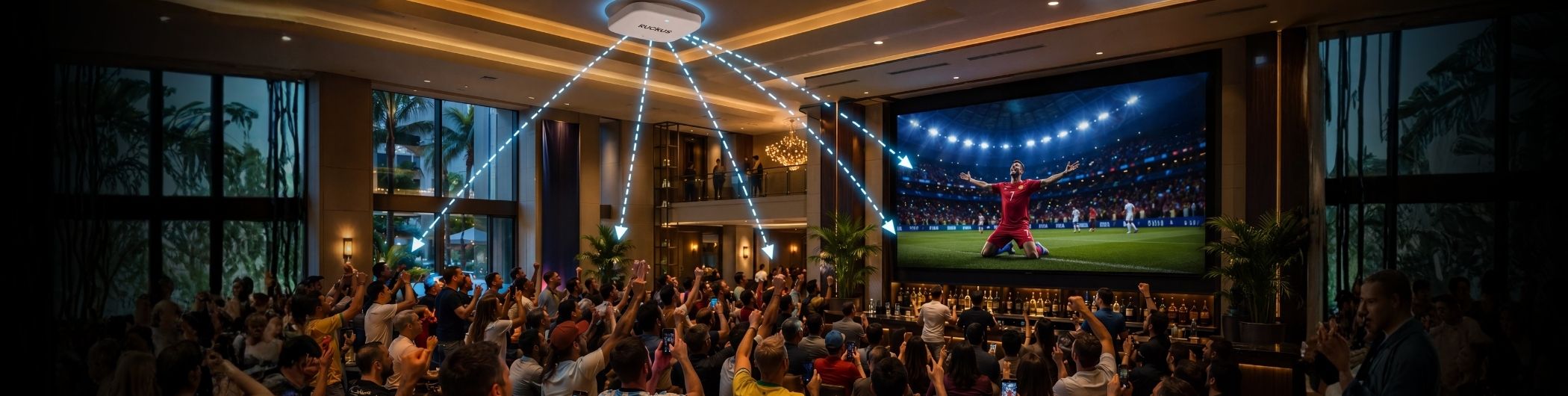
The 2026 World Cup isn’t just a global event, it’s a full-scale stress test for networks under real-world pressure. Hotels across North America are seeing surges in occupancy, with many properties operating at or near capacity. Every room is occupied. Every screen is on. Guests are streaming matches, posting highlights, and connecting multiple devices at once.
What used to be predictable peaks in network usage has shifted into something far more demanding, constant, high-density connectivity throughout the day. And in this moment, one thing becomes clear: when connectivity struggles, the entire guest experience feels it.
When demand surges, traditional networks fall behind
During moments like this, demand doesn’t just grow, it concentrates, spikes, and never slows down. A single room can now generate more data traffic than entire floors did just a few years ago, and it’s happening everywhere, all at once. Lobbies are packed, viewing areas are full, and operational systems are running nonstop in the background.
Many networks don’t fail because they lack bandwidth, they fail because they can’t adapt. They react too slowly, rely on manual intervention, and struggle to balance guest traffic with critical hotel operations. That reactive model simply doesn’t hold up when thousands of devices are online simultaneously.
When performance breaks, guests notice
Guests don’t think about connectivity – until it breaks at exactly the wrong moment. Buffering in the middle of a decisive goal. Dropped connections in a crowded lobby. Digital services like kiosks, hotel apps and mobile check-in slow exactly when guests need them the most. Inconsistent performance from one area of the hotel to another.
During a high-profile event like the World Cup, these experiences don’t stay private. They surface immediately in reviews, social posts, and real-time feedback. The impact to hotel owners is direct and measurable: lower guest satisfaction, operational strain, and missed revenue opportunities. When the network fails, the guest experience fails with it.
Guest experience and operations are connected
The challenge doesn’t stop with guest Wi‑Fi. Behind the scenes, hotel operations rely on the same infrastructure, supporting smart locks, IPTV, security systems, property management platforms, and staff communications. During peak demand, these systems must perform flawlessly, even as guest traffic surges. That creates a balancing act. Connectivity is no longer just a guest amenity; it’s the foundation for both the guest experience and the hotel’s ability to operate efficiently.
The shift to adaptive, high-density networking
Handling this level of demand isn’t about adding more capacity, it’s about adapting in real time. Modern hospitality environments require infrastructure that can continuously optimize performance, intelligently distribute connections, and maintain consistency across every space on the property. In high-density areas, adaptability becomes the difference between stability and disruption.
This is where purpose-built solutions like RUCKUS access points and AI‑driven network management platform such as RUCKUS One® make a difference, helping manage interference, balance client loads, and delivering reliable performance even at peak occupancy. The goal isn’t just to keep up. It’s to stay ahead of demand as it grows.
A glimpse of the future of hospitality
World Cup is not a one-time anomaly. It’s a preview of where hospitality is heading. Device density will continue to rise. Guest expectations will continue to grow. Digital services will continue to expand across the hotel experience. Networks must evolve alongside these shifts, delivering consistent performance, faster responsiveness, and greater operational simplicity through automation. Adaptive, resilient networks are no longer optional. They’re becoming the standard for how connectivity supports modern environments.
The competitive advantage is already clear
At moments of peak demand, the difference between properties becomes obvious. Where networks perform, everything else follows. Guests stay connected without frustration. Services remain responsive, staff operate efficiently and operations continue without disruption. It’s not just better performance - it’s a better experience. And it's one guests remember.
What comes after the final match
The World Cup will come to an end - but the elevated demand it exposes will continue long after the final match. Hotels that use this moment to evaluate and improve their network infrastructure will be better prepared for what’s ahead. Those that don’t will continue to feel the strain as expectations rise with every major event. The question isn’t whether demand will increase -it already has. The question is whether your network is ready to keep up. Your guest experience deserves a winning game plan. Talk to a RUCKUS specialist about your property’s network readiness.
*FIFA World Cup 2026™ is a trademark of FIFA. RUCKUS Networks is not affiliated with, endorsed by, or sponsored by FIFA.