
Authors

In this Article
The Old Model Is Breaking Down
For decades, network operations have followed a familiar pattern: engineers monitor dashboards, triage alerts, diagnose root causes, and apply fixes, often under pressure, and often at 2 a.m. Each generation of tooling automated part of that loop, but the operating model itself remained largely human-driven.
That model is straining under the weight of three converging pressures:
Network complexity is outpacing human capacity. Modern enterprise environments span wireless, wired, and multiple services simultaneously. The number of variables a human can effectively process during a live incident is finite; the networks generating those variables are not.
The talent gap is widening. Experienced engineers are retiring faster than new experts can be developed. Hard-won operational knowledge, the kind that lets a senior engineer diagnose a client issue in minutes, walks out the door with them and doesn't come back easily.
AI models are finally capable enough to help. For years, "AI in networking" mostly meant dashboards with smarter labels. That has changed. With stronger language reasoning and domain-specific tuning, AI systems can now interpret network conditions, identify failure patterns, and support, or in some cases execute, operational decisions in ways that weren't practical before.
These three forces aren't arriving independently. They're arriving together, and they're arriving now.
The Evolution: From Alerts to Autonomy
The journey toward autonomous networking hasn't been a single leap, it's been a deliberate progression through four distinct operational stages:
Stage 1: Observability: The foundation. Network-wide telemetry, performance metrics, health dashboards, and historical trend analysis across deployment types. Without this raw signal, nothing above it works. Teams went from flying blind to having visibility.
Stage 2: AIOps Insights: Machine learning models identify user experience degradation, correlate events across the network, and surface actionable incidents before they escalate. This is where the industry moved from reactive operations, fixing what broke, to proactive operations: catching what's about to break.
Stage 3: Automated Remediation: Intent-based AI translates high-level operational goals into specific network actions. Automated remediation workflows close the loop from detection to resolution without requiring manual intervention for every event.
Stage 4: Agentic Operations: The frontier. AI agents with natural-language understanding, expert-level reasoning, and autonomous decision-making, operating within a governed framework, explaining their actions, and increasingly handling what used to require a skilled engineer on-call.
Each stage amplifies the one beneath it. Agentic AI without a foundation of observability, insight, and remediation is just a chatbot. The full stack is what makes agents operationally meaningful.

What "Agentic" Actually Means in Practice
The term "agentic AI" is becoming overused. It's worth being precise about what it means for network operations, and what it doesn't.
An agentic system doesn't just surface information or suggest actions. It can reason about a problem, take corrective action, and explain its decisions in plain language. The distinction matters: moving from "here's an alert" to "here's what I diagnosed, here's what I did about it, and here's why" is a fundamentally different operational experience.
There are two meaningful forms this takes in a network context:
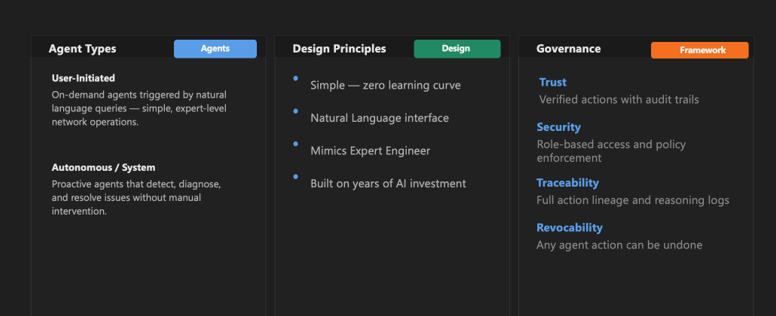
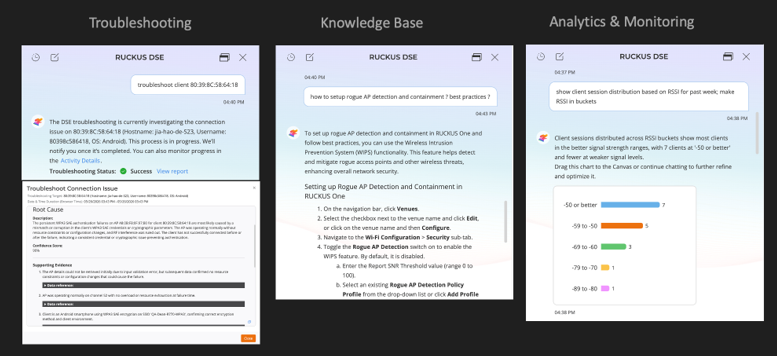
Interactive agents respond to natural-language questions from operators. Instead of navigating multiple screens or running command-line workflows, an engineer asks, "Why is client ABC experiencing slow connections?" The agent investigates across the stack and returns an explanation with recommended next steps. The interface is conversational; the reasoning is expert-level.
Autonomous agents are system-initiated, they monitor continuously, predict conditions, and respond to network events within policy guardrails without waiting for a human to intervene. They handle auto-remediation, security response, and compliance workflows, then log what they did and why.
The common thread is that both types operate in natural language, both are designed to reflect the reasoning patterns of experienced network engineers, and both aim to make advanced operations accessible, even to teams without deep networking expertise.
RUCKUS Agentic Operations: Built on a Proven Foundation
RUCKUS's answer to this shift is Agentic Operations, a new class of AI-powered agents now rolling out as part of the RUCKUS One platform. What makes the approach credible is that it isn't built on a single product launch. It sits at the top of a carefully constructed AI stack, with each layer already deployed in production across thousands of customer environments.
The first three layers, observability, AIOps incident detection, and intent-based automated remediation, are live. They have already reduced mean time to resolution for incidents and eliminated hundreds of manual hours typically required for network fine-tuning. Agentic Operations builds on that proven foundation, introducing advanced autonomous reasoning as the next layer rather than a replacement for what's already working.
The platform spans both wireless access points and wired ICX switching infrastructure through a unified management experience. That matters because real-world network issues rarely respect domain boundaries, a wireless client problem often traces back to a wired switch misconfiguration, and an agent that can only see one side of that equation will miss the root cause.
DSE: The Orchestration Engine
For interactive agents, the operational engine is DSE, the Digital Systems Engineer, an AI-powered assistant embedded in RUCKUS One. RUCKUS positions DSE not as a single generalist model, but as an orchestrator coordinating specialized agents with clearly defined scopes and domain-specific competence.
When an operator asks, "Why is the guest Wi-Fi slow in the lobby?", the orchestrator decomposes the request, routes subtasks to the right specialist sub-agents, and synthesizes the results into a coherent answer. This architecture reflects a practical lesson from enterprise AI deployment: focused sub-agents with specific skillsets and bounded authority are easier to validate, govern, and improve over time than a single agent trying to do everything at once.
Governance: Autonomy Without Chaos
Giving AI agents the ability to change network configuration is powerful. Without guardrails, it's also risky. RUCKUS's governance model rests on four pillars:
- Trust: Agents operate within explicitly authorized scope, and that scope expands only as confidence in their performance grows.
- Security: Role-based access control and layered authentication prevent unauthorized changes or privilege escalation.
- Traceability: Every meaningful decision has a documented lineage: trigger event, reasoning path, resulting action. That record is essential for operational confidence and compliance.
- Revocability: Human operators retain override authority. Agent-initiated actions are designed to be reversible.
The operating model is explicit: autonomous networking with human oversight. AI handles speed and complexity; humans retain responsibility for judgment, policy, and strategy.
RUCKUS Networks is rolling out Agentic Operations as part of the RUCKUS One platform. DSE and related agent capabilities are in active development, with customer-facing availability expanding over time.
What the Road Ahead Looks Like
Agentic Operations is rolling out in stages, but the directional arc is clear:
Near-term: Interactive agents improve troubleshooting, analytics, and guided remediation, giving IT teams an expert co-pilot for everyday operations.
Mid-term: Autonomous agents take on common remediation workflows, security response patterns, and performance optimization tasks within explicit policy boundaries.
Long-term: Self-optimizing networks increasingly tune themselves around business intent, user behavior, and predictive models, while people stay focused on governance and outcomes.
The destination, networks that increasingly help solve their own problems with humans focused on what requires human judgment, is being built layer by layer. For teams managing growing infrastructure with flat or shrinking headcount, that shift isn't just a capability upgrade. It's a different way of working.


