



The Case for an Enterprise Networking Approach to AV-over-IP
Modern professional AV environments are increasingly built on IP networks. Audio, video, and control systems now rely on AV-over-IP technologies that introduce specialized traffic patterns, including multicast, strict latency requirements, and the need for real-time quality of service (QoS). Capabilities such as IGMP snooping, traffic prioritization, and buffering are essential to delivering a reliable AV experience.
However, deploying and managing these features typically requires advanced networking expertise that may not always exist within AV integration teams or end-user organizations. As a result, AV deployments often depend on custom switch configurations, manual tuning, and trial-and-error troubleshooting.
At the same time, AV workloads continue to grow more demanding. Ultra-high-definition video, multi-stream distribution, immersive experiences, and real-time collaboration significantly increase requirements for bandwidth, latency control, and reliability. When these workloads are placed on general-purpose switches that are not optimized for AV traffic, organizations may face longer deployment timelines, configuration errors, operational complexity, and inconsistent system performance.
The Evolution of AV Networks: From Fixed Signals to IP-Based Infrastructure
Professional AV networks have undergone a fundamental transformation over the past decade. Traditionally, AV systems were built using dedicated, point-to-point signal paths. Sources such as cameras, media players, or computers were directly connected to displays, projectors, or matrix switchers using purpose-built cabling and interfaces.
Traditional AV: Dedicated Signals, Fixed Architectures
Legacy AV deployments relied on analog and non-IP digital technologies such as VGA, HDMI, DisplayPort, DVI, and SDI, along with control mechanisms like RS-232, IR, or proprietary control buses. These systems treated each signal as a physical connection, resulting in fixed architectures where routing and scaling required additional hardware and cabling.
This approach delivered clear benefits. Signals were uncompressed, latency was effectively zero, and performance was highly predictable. For small or static installations, troubleshooting was straightforward and no network configuration was required.
However, these advantages came with significant limitations. Distance was constrained, scalability was poor, and complexity increased rapidly as systems grew. Large deployments required extensive cabling, centralized matrix switchers, and vendor-specific ecosystems. Monitoring and diagnostics were limited, and extending AV systems across buildings or campuses was often impractical.
AV Over IP: Signals Become Data
Modern AV environments increasingly rely on AV-over-IP architectures, where audio, video, and control signals are packetized and transported over standard Ethernet networks. Instead of fixed point-to-point wiring, sources and displays connect to network switches, enabling many-to-many routing similar to other IP-based applications.
This shift has introduced a broad ecosystem of technologies and standards, including protocols such as Dante and AES67 for audio, NDI and SMPTE ST 2110 for video, and a range of proprietary but widely adopted AV-over-IP platforms. Standard Cat6/6A cabling and fiber optics enable significantly longer distances, while IP-based control allows integration with web interfaces, APIs, and centralized management systems.
Treating AV signals as data streams fundamentally changes what is possible. Routing becomes virtual rather than physical, reconfiguration is software-driven, and AV systems can scale across rooms, buildings, and even geographic locations. Centralized monitoring, remote management, and tighter integration with IT infrastructure become achievable, and increasingly expected.
New Capabilities, New Network Demands
While AV-over-IP delivers flexibility and scalability, it also introduces new challenges. AV traffic has unique characteristics: multicast-heavy video streams, strict latency and jitter requirements, and sensitivity to packet loss. Ensuring consistent performance requires proper support for multicast control, traffic prioritization, buffering, and real-time quality of service.
Unlike traditional AV, performance in an IP-based environment depends heavily on switch capabilities and configuration. VLAN design, QoS policies, and multicast handling must be correct, or organizations risk inconsistent behavior, extended deployment timelines, and difficult troubleshooting.
This is the inflection point many organizations face today: AV systems now operate on IP networks, but they often demand networking expertise that AV teams may not have and time and specialization that IT teams may not want to dedicate to AV-specific tuning.
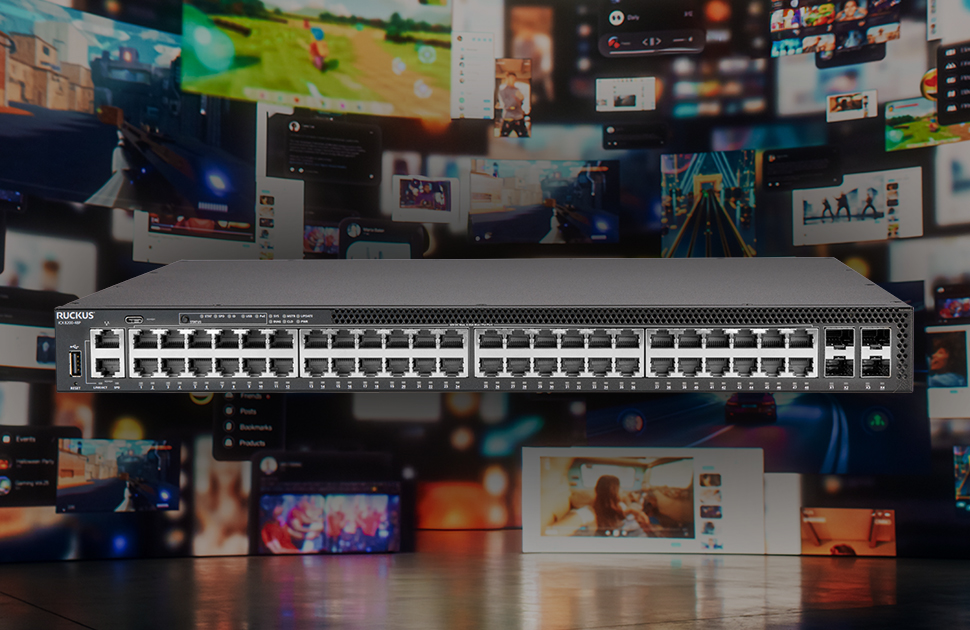
New ICX Pro-AV switches simplify AV over IP
A Converged Future for AV and IT
The shift from physical signals to IP streams has effectively transformed AV infrastructure into an extension of the enterprise network. AV is no longer an isolated system; it is a workload running alongside business-critical applications.
This evolution sets the stage for a new approach, one where AV networks are designed with enterprise principles from the start, allowing IT teams to retain control while AV teams benefit from predictable, purpose-built performance.
A Shift in Responsibility: AV Networks Meet IT Standards
As AV systems become business-critical, organizations are rethinking how AV networks are designed and operated. Rather than treating AV as a specialized overlay that sits outside the IT domain, many are bringing AV networking back under IT governance.
This shift benefits both teams. IT regains control over the network stack, visibility, and security posture, while AV teams gain a predictable, standards-based infrastructure that works out of the box, without requiring deep expertise in networking protocols.
Purpose-Built Switching for Professional AV
RUCKUS ICX Pro AV switches are designed specifically to address the networking requirements of professional AV deployments while aligning with enterprise IT practices.
The ICX Pro AV product line delivers preconfigured, AV-optimized profiles out of the box. These configurations are designed to support common AV-over-IP requirements, such as multicast handling and traffic prioritization, without requiring custom network design or specialized tuning during installation. In many cases, deployment is truly plug-and-play: drop the switch in, connect endpoints, and get predictable results.
Built on the proven RUCKUS ICX enterprise-class switching architecture, evolved from the long-standing Foundry Networks FastIron switching platform, ICX Pro AV switches support high-speed connectivity up to 100 Gbps per port. This performance headroom enables demanding use cases such as 4K and 8K video distribution, large-scale multicast audio, and real-time collaboration across high-density environments.
The switches integrate seamlessly with existing RUCKUS management platforms, including RUCKUS One and SmartZone. This provides centralized visibility, operational consistency, and alignment with established IT standards, management workflows, and security policies, eliminating the need to operate AV networks as isolated systems.
Business Benefits Across Key Verticals
Higher Education
Higher education institutions deploy AV systems across classrooms, lecture halls, auditoriums, collaboration spaces, and large public venues such as stadiums, arenas, and event centers. In addition to instructional technologies like lecture capture, live streaming, and hybrid learning, campuses increasingly rely on networked AV to support digital signage, high-density video distribution, and guest-facing services across academic, athletic, and public environments.
ICX Pro AV switches support consistent and predictable network behavior across diverse campus settings, from classrooms to large-scale venues with extensive video equipment and multicast traffic. By integrating seamlessly with existing enterprise network architectures, the platform enables closer collaboration between AV and IT teams while maintaining campus security, operational consistency, and scalability. High-capacity switching provides the performance and headroom required to support bandwidth-intensive AV workloads in stadiums and large venues, while allowing institutions to evolve their AV infrastructure as application requirements continue to grow.
Hospitality
Hotels, resorts, and convention centers rely on AV networking for guest services, digital signage, meeting spaces, and large-scale events. ICX Pro AV switches simplify deployment across distributed properties through standardized configurations and centralized management.
Predictable network behavior helps ensure consistent AV performance across guest rooms, public areas, and event venues. Centralized monitoring reduces operational overhead and supports efficient management across multiple floors or buildings.
K–12 Education
K–12 schools increasingly depend on networked AV systems to support interactive classrooms and hybrid learning models, often with limited IT staffing. ICX Pro AV switches reduce deployment complexity through preconfigured AV networking capabilities that minimize manual tuning.
By standardizing both AV and IT traffic on a common infrastructure, school districts can simplify operations, improve reliability, and manage costs more effectively over time.
Pro Residential (Luxury Homes)
In high-end residential installations, AV networks support whole-home video distribution, immersive audio, and home automation systems. ICX Pro AV switches provide preconfigured AV profiles that reduce installation time and complexity while supporting high-bandwidth media formats.
Compact form factors, fan-less design for some models and enterprise-grade reliability make the switches well suited for residential environments where space, noise, and long-term maintenance are key considerations.
The Bottom Line
RUCKUS ICX Pro AV switches provide a standardized, enterprise-grade networking platform purpose-built for professional AV deployments. By combining preconfigured AV networking features with high-performance switching and centralized management, the platform reduces deployment complexity, delivers predictable performance, and enables AV networks to scale within established IT frameworks.
With ICX Pro AV, organizations no longer need to choose between AV performance and IT control; they can finally have both.
To learn more about how RUCKUS is simplifying AV-over-IP with an enterprise-grade approach, access the RUCKUS ICX Pro AV solution page to see how purpose-built switching supports predictable, high-performance AV deployments. You can also review the RUCKUS ICX Pro AV datasheet for detailed technical specifications and deployment options.