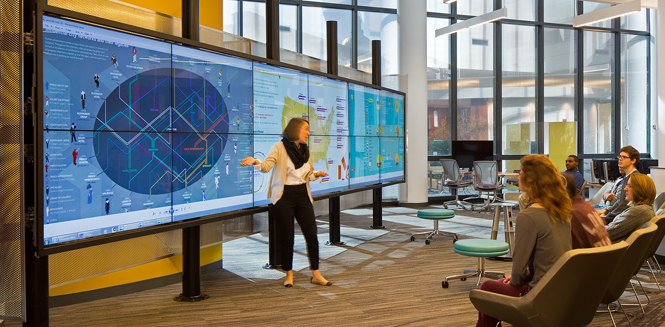

In many ways, a modern university is akin to a small city, complete with residential areas (dorms), a city hall (administrative buildings), business centers (classrooms and libraries) and commercial districts (student unions and retail). The larger the university population, the more the campus mirrors the challenges faced by small cities.
During peak season at larger universities, a community can easily swell to a size that rivals the largest cities of Delaware and Maine. And that doesn’t include college game days when some on-campus football stadiums dwarf all professional sports arenas in the U.S.
Campuses offer accommodations similar to what you’d expect to find in metropolitan areas. But where these self-contained ecosystems differ from a typical city is the availability of a robust, ubiquitous wireless network throughout campus. From the lecture halls and rec centers to the dorms or student unions, residents and visitors alike expect pervasive, always-on connectivity. And depending on what section of the campus, the Wi-Fi® network will run up against a variety of unique challenges. Here are a few:
Wi-Fi and Network Demands in Classrooms and lecture halls
In a way, classrooms and lecture halls are like the business centers of these mini-cities, with hundreds of people entering and exiting buildings throughout the day. These sites are the beating heart of academia that feed off the wireless network.
Here, it’s common to find lecture podiums with built-in audio-visual capabilities and controls, as well as rooms with IoT lighting and environmental controls. Plus, faculty and students often have two or three devices connecting to the Wi-Fi network simultaneously—not to mention smartboards for enhanced learning. With some lecture halls able to hold up to 300 students, the amount of wireless traffic in just one room would be enough to choke most ordinary networks.
And don’t forget: This traffic multiplies when you add the variety of working spaces for practical studies, small group learning and, of course, program-specific research labs that deal in huge datasets and detailed images.
University Library Wi-Fi for Research, Streaming, and Collaboration
University libraries function as the information district of the campus city. It’s the central repository of knowledge, much like a city’s historical archives or the main city library. Today’s college library has evolved significantly and, arguably, has benefited the most from IT technology and Wi-Fi connectivity advancements.
Libraries are no longer just stacks of books; they’ve become multimedia hubs where students stream educational videos, download ebooks, and connect to online databases and the cloud. Collaborative spaces and group study rooms demand smooth video conferencing, while quiet study zones call for silent but strong connections.
Surely, you will still find the floors of stacks containing a wide variety of volumes and collections. And yes, the Dewey Decimal System is still widely utilized. But those 3x5 paper cards of old are now electronic records. What’s more, most collections of microfiche and film reels have been digitized and can only be accessed through electronic repositories. Data and article collection for research projects that previously required days and weeks to perform can now be completed in a single visit to the library, but they demand extensive bandwidth.
Dorm and Student Housing Wi-Fi at Campus Scale
If classrooms and lecture halls are like the business centers of a small city, then dorms and campus apartments are residential neighborhoods in the urban district. With student populations that can range from 15,000 to 70,000 residents, university student housing emulates the complexity, infrastructure needs and social dynamics of your average metropolitan hub.
Consider the real connectivity demands of a typical residence hall: Today’s students are digital natives, and each residence hall houses hundreds (sometimes thousands) of students. In every room, they expect to connect multiple devices: laptops, tablets, smartphones, gaming consoles, smart TVs, and IoT gadgets like printers, smart speakers and streaming sticks simultaneously. Multiply that across the building and you’re working with the density of a downtown high-rise.
On top of that, many universities now run digital services that depend on the connectivity of the residential neighborhood: smart laundry systems, keyless entry, online work orders for maintenance, and even AI-driven resident engagement apps. All of this puts massive pressure on a campus network.
Campus Stadium and Event Wi-Fi for Large Public Venues
It’s not unusual for a traditional university to have football, soccer, baseball and track stadiums; basketball, volleyball and gymnastics facilities; a fieldhouse, a natatorium, tennis courts, and a golf course; as well as amphitheaters, Greek theatres, band halls and concert arenas. As in most small cities, these locations are the nerve centers of residential life. It’s here where tens of thousands of students, fans and visiting teams come together to share in recreation and excitement.
To heighten this experience, these venues offer scoreboards, digital signage and live-action monitors that are all dependent on the wireless network. Add to that digital tickets, cashless payment systems and the thousands of guests using apps to follow the action, and you’ve got a high-density challenge that could critically impact the fan experience should anything go wrong. During these events, Wi-Fi is the lifeblood of these venues.
Secure Wireless Networks for University Administrative Offices
In this small city, the university’s business offices are the administrative backbone—the city hall, if you will—of this burgeoning mini-metropolis. This is where the governance of the campus takes place: everything from student registration and financial aid to payroll and campus security.
Here, digital security is paramount. Protecting the sensitive academic records, research data, and personal information of community members is priority one. These offices rely on wireless networks for day-to-day operations, including email, file sharing and access to administrative software.
But the network must be able to distinguish between trusted users and potential threats while maintaining the open, collaborative environment that defines higher education. These administrative buildings might not receive the same attention that student spaces do, but they’re running critical operations that are fundamental to keeping this small city functioning. Any network failure here can bring the city’s essential services to a halt.
Campus Wi-Fi for Student Centers, Dining, and Retail Spaces
In addition to the auditoriums and sports arenas, each of these campus-cities features business districts and public spaces where residents can meet up, shop and relax. From student unions and dining halls to bookstores, cafes, and food courts, a robust, campus Wi-Fi is the grease that keeps the wheels of commerce turning.
But a campus wireless network in these commercial business areas does more than support businesses. It serves a dual purpose: It supports enterprise systems for businesses by providing seamless guest access for visitors and students. These POS systems, inventory tracking, and mobile payments all count on fast, secure wireless to keep the lines moving and sales flowing. Inconsistent wireless service could mean downtime at the register or, worse, lost revenue. And on a busy homecoming or big game weekend, the number of transactions could easily double or triple—making these places, more than any other, critical in supporting the social fabric of the campus.
Why Campus-Wide Wi-Fi Is Now a Student Experience Requirement
Running a small city, aka a college campus, isn’t easy. It requires a lot of strategy, planning and careful execution. Building a pervasive, ubiquitous wireless network that works seamlessly across every point of contact can be vital to a school’s success.
While academics and tuition remain top-tier decision factors for selecting an institution, research shows that the on-campus network environment is also highly relevant to the student decision-making process for their next four years. For example, a student legislature at a large southwest university (student population 35,000) recently passed a resolution urging their campus administrators to significantly improve their Wi-Fi campus network. In other words, quality Wi-Fi networks are long past the days of being a “nice to have” on campus.
Today, a robust Wi-Fi network has become table stakes in a world where students were born into a technology-rich environment. Students simply expect the network to be available, reliable and with enough bandwidth such that they don’t even notice the network.
Fortunately, at RUCKUS®, this is exactly what we do every day. We survey, design and deploy purpose-built networks for higher education campuses, MDUs and large public venues. Our collaborative, step-by-step process helps us learn and understand the uniqueness of your campus so we can address your specific requirements and deliver the end results you expect.
To help you better understand how we work with colleges and universities, we’ve developed a series of solution guides to assist you with starting a conversation with our team. Use them to help you understand our step-by-step process of modernizing your on-campus network to Wi-Fi 7 while still considering the implications of the 6 GHz frequency.
To see how RUCKUS supports higher education networks across the entire campus, explore our Higher Education solutions brochure.
Read the other blogs in this series:
- Campus Libraries Have the Same Needs as Those of a Small City
- Like City Hall in Small Cities, Administration Is Critical to Your Campus-City
- When a Campus Becomes a Small City Overnight: Wi-Fi for Large Event Traffic
- Student Centers as Commercial Districts in the Campus Network
- Why Student Housing Functions Like High-Density Residential Neighborhoods on Campus
- University Classrooms Function as Business Centers in the Campus Network